


Hundreds of people, including farmers and farming activists from Taiwan, Thailand, Indonesia, South Korea, Japan and Malaysia, yesterday rallied against the globalization of agriculture on Ketagalan Boulevard in front of the Presidential Office, protesting against the government’s plans to lift more bans on agricultral imports.
“We gather here today to express our anger, we want to tell the government that we’re fed up with their compromises on our food sovereignty, it’s a serious problem that our food self-sufficiency has dropped to 33 percent now,” Taiwan Rural Front (TRF) spokeswoman Tsai Pei-hui (蔡培慧) told the crowd at the rally. “You’ve put our dining tables and refrigerators in other people’s homes, we want to keep them in our own places.”
In addition to a series of heated protests against land expropriations that have been going on for years, farmers and farming activists are worried that the government may soon lift the bans on imports of 830 categories of farm products from China, as well as pork products from the US, despite President Ma Ying-jeou’s (馬英九) repeated promises that he would not do so.
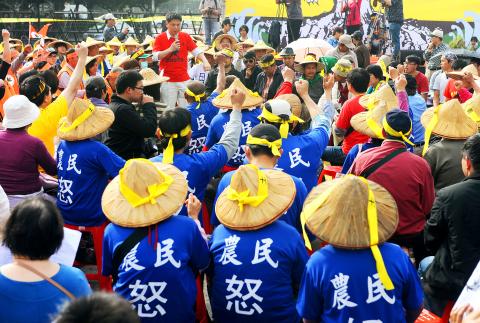
Photo: Liao Chen-huei, Taipei Times
“During the presidential campaign, Ma promised numerous times that he would not lift the bans on imports of 830 categories of farm products from China, but now, Council of Agriculture Minister Chen Bao-ji (陳保基) is saying that the bans ‘may’ be lifted,” said National Cheng Chi University land economics professor Hsu Shih-jung (徐世榮), a long-time advocate of farmers’ rights. “When the government decided to lift the ban on imports of certain US beef products amid strong opposition from the public, Ma also firmly promised that the imports of US pork products would remain banned — yet the US government is now pressuring the Ma administration to lift the ban.”
Hsu said farmers across the country now “have little confidence in this incapable government” and therefore gathered to voice their opposition to free trade in the agricultural sector and to call on the government to insist on agricultural sovereignty.
Henry Saragih, the general coordinator of the Jakarta, Indonesia, office of international small farmers’ organization La Via Campesina, said that the problems that Taiwanese farmers encounter are the same for farmers across the world.
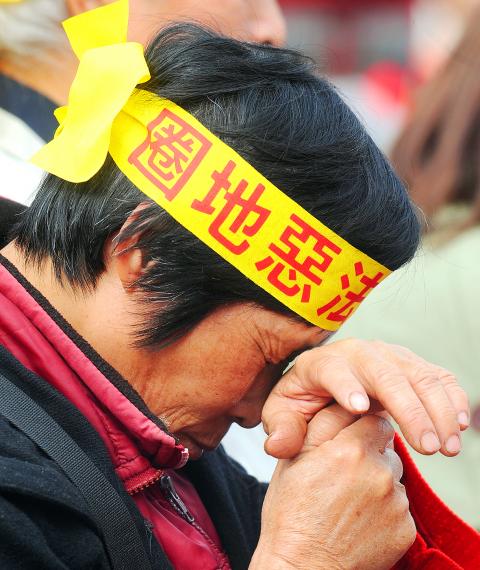
Photo: Liao Chen-huei, Taipei Times
La Via Campesina is an international coalition of peasants’ movements with 148 member groups in 69 countries around the world.
“Land grabbing, loss of food sovereignty and an increasing number of people threatened by famine — now reaching more than 1 billion — are problems created by the WTO, globalization and neo-liberalism,” Saragih said.
He said that Thailand, for instance, which originally had a diverse agricultural sector, now specializes in producing rice for export, and has to import other produce.
South Korea has become an exporter of electronic products, “and since most of its farmland has been taken by the industrial sector, some South Korean agricultural companies now grab land in Africa — especially Madagascar — to grow produce to be imported back to South Korea, leaving Madagascan farmers landless,” Saragih said.
Wirat Phromson, a member of the Northern Peasants’ Federation Thailand, urged farmers in Taiwan to continue their struggle.
Citing the farming rights movement in Thailand, Phromson said that despite the seeming flexibility of the Thai government and its promise to revise laws, “the [Thai] government eventually amended laws concerning the agricultural sector, but not for the interests of the peasants. Rather, it was for the interests of big corporations.”
“We want to tell our brothers and sisters in Taiwan and in Via Campesina: Do not believe those empty promises of the government,” he said. “We can’t let people from outside take valuable resources from us and impose on us the sufferings of hunger.”
Following performances by musicians in the evening, the rally ended with protesters throwing bundles of straw toward the Presidential Office.

‘NO SECURITY RISK’: The Railway Bureau reassured the public that the technicians’ activities were limited to technical guidance and did not involve sensitive systems The Railway Bureau yesterday said it had invited eight Chinese technicians to assist with an airport MRT construction project. The bureau issued the confirmation after an Internet user said Chinese nationals had entered the construction zone of Taiwan Taoyuan International Airport’s Terminal 3 project. They asked why “individuals from an enemy state” were allowed access to such a major national infrastructure project, which raised serious concerns over Taiwan’s industrial safety, sensitive systems and information security. The bureau’s Northern Region Engineering Branch Office said subcontractor Taiwan Handle Industrial Co (台灣手把工業) of the Taoyuan airport MRT’s “Contract No. CU05 Project A14 Station Civil, MEP &

A US uncrewed surface vessel (USV) encountered multiple Chinese warships during an autonomous transit of the Taiwan Strait, US defense company Seasats said in a statement on Wednesday. Seasats announced that a Lightfish USV had completed the first autonomous transit of the Taiwan Strait. Over five days, the USV traversed the entire length of the Strait while constantly monitoring surface vessel traffic, the company said. The Lightfish encountered multiple Chinese warships, one of which was a Chinese People’s Liberation Army Navy (PLAN) Type 056 corvette, it said. The Chinese vessels were operating “well within Taiwan’s exclusive economic zone without transmitting their identity via the
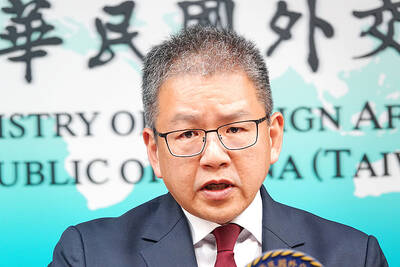
Taiwan is still in the process of assessing the possibility of recruiting workers from Eswatini, the Ministry of Foreign Affairs said yesterday, adding that its goal is to help Eswatini upgrade its vocational training centers. If there are plans to recruit workers from Eswatini, safeguarding national security, protecting public health and ensuring the employment rights of Taiwanese would be prerequisites, Department of West Asian and African Affairs Director-General Yen Chia-liang (顏嘉良) told a news conference. Key considerations would also include filling labor shortages in specific industries, and fostering bilateral professional and technical exchanges, he said. Yen was asked about the progress of labor
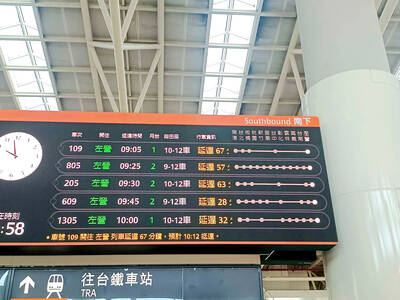
The nation’s usually punctual high-speed rail system yesterday was hit by major disruptions after all scheduled services were canceled and replaced with three hourly trains offering only non-reserved seating, affecting more than 200,000 passengers. Preliminary findings indicate the disruption was caused by a faulty power module in a track switch control cabinet, Taiwan High-Speed Rail Corp (THSRC) said, adding that as a full system inspection could only be conducted after operations end for the day, a decision on whether normal service would resume today would be announced before the first train departs. During a routine inspection early yesterday, a switch signal abnormality


 RSS
RSS